- Renegade — Henry Miller and the Making of ‘Tropic of Cancer.’ — By Frederick Turner — Book Review - NYTimes.com 012912
Jeanette Winterson: “It is some 50 years since “Tropic of Cancer” was published in the United States by Grove Press. First published in Paris in 1934 by Obelisk, a soft-porn imprint, it had been banned as obscene in America until a landmark legal victory overturned the ban, allowing Grove to print it legally in 1961. The book became an instant best seller, and Henry Miller stood as the priapic prophet of sexual freedom. Frederick Turner’s aim in “Renegade” is to explain how “Tropic of Cancer” came to be written, came to be banned and came to be an American Classic.” - Ben Jonson - A Life - By Ian Donaldson - Book Review - NYTimes.com 012312
The contrasting lives — and posthumous fates — of Jonson and Shakespeare are a minor but recurring theme in the deeply researched but happily readable new biography of Jonson by Ian Donaldson, entitled “Ben Jonson: A Life.” A general editor of the forthcoming seven-volume “Cambridge Edition of the Works of Ben Jonson,” Donaldson has a case to make that, despite the Shakespearean eclipse, Jonson was as central to the development of the British theater as Shakespeare was — in some ways perhaps more so, at least during the years in which their plays were first produced.
- Facebook Timeline Brings The Past Back To The Future | WBUR & NPR 012912
Facebook’s Timeline — the long-anticipated overhaul of the site — is rolling out across the world this week. Timeline allows friends to surf through all your posts going back to the beginning of Facbeook time. Graphically it can be a beautiful thing. Mark Zuckerberg calls it a chance for users to tell the stories of their lives. And over the next few weeks, users across the world will get it on their profile. But here’s the important part — once you get it, you will have just seven days to clean up all your old posts and make it presentable to the world. The problem with Facebook’s Timeline is that the story you chose to tell about your life back in college in 2004 might be considerably different from the story you would like to tell about your life now. But Timeline will make all those old posts and photos documenting things back in the day easily visible to the world.
- Everyone Should be able to Access the Internet - On The Media 012712
Brooke asks Harvard Law professor and co-founder of the Berkman Center for Internet and Society Jonathan Zittrain if access to the internet should be considered a human right. He says that according to the Universal Declaration of Human Rights, everyone has the right to receive and impart information through any media, and today’s media of choice is the internet.
- Who Owns Data From Inside Your Body? - On The Media 012012
If you have an implanted medical device that can collect data in your body, who owns that information? There doesn’t appear to be a clear answer to the question. Brooke speaks to Hugo Campos, a patient advocate and founder of the ICD User Group, about his unsuccessful attempt to obtain the data collected by his own implanted defibrillator.
- A Wild Week for Online Piracy - On The Media 012012
This week saw more then its share of internet drama. The US Government led a massive operation against the website MegaUpload. And dozens of major websites staged a blackout in protest of two proposed laws - the Stop Online Piracy Act and the Protect IP Act. Bob talks to Techdirt’s Mike Masnick about the implications of the proposed legislation and the foment online.
About the Flaneur
![Gustave Caillebotte. Paris Street, Rainy Day (La Place de l’Europe, temps de pluie). 1877. Oil on canvas. Art Institute of Chicago. [Source: Wikimedia Commons]](../../../../wp-content/uploads/2009/02/gustave_caillebotte_paris_street_rainy_day_1877_wiki.jpg "gustave_caillebotte_paris_street_rainy_day")
I walk through my blindness the way I wander down streets in Paris: unfettered and alive, alert to the raw material of the senses. I am a flaneur. Come along with me. Just don’t try to take my arm, unless I ask. What’s a flaneur? Read the first post, Return of the Flaneur to Galerie Vivienne. After that, try Foot Rage and the Blind Flaneur. Then stay tuned.Letting Go of Sight
![Fog at Isle Royale [Source: wildmengoneborneo.com]](../../../../wp-content/uploads/2008/04/isle_royale_fog.jpg "Fog at Isle Royale [Source: wildmengoneborneo.com]")
I’ve canoed on Lake Superior for almost as many years as I’ve been losing eyesight. I return year after year like a migrating loon to learn the other side of a slow, uncertain process that we could call “going blind.” After 35 years with the lake as my teacher, I know what lies on the other side. I call it letting go of sight. Read Big Water. See more about the Great Lakes.Not This Pig
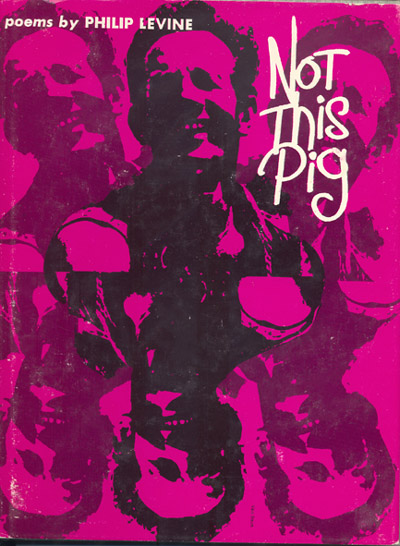 If there is an emerging genetic underclass, I could run for class president or class clown. Read more in Not This Pig (2003).
Media in Transition @ MiT
Disabled Americans today have to negotiate for the kinds of accommodations made for FDR, and the caveat “reasonable accommodation” is built into the law. President Franklin Roosevelt did not have to negotiate. He could summon vast resources of the federal government – money as well as brains – to accomplish the work of disability. And it was accomplished with such thoroughness and efficiency that its scale could be called the Accessibility-Industrial Complex had it been directed toward public accommodations and not solely the needs of a single man. Read FDR and the Hidden Work of Disability [MiT8 2013]
Shepard Fairey claimed that his posterization of a copyrighted AP news photo of Barack Obama was a transformative work protected by the fair use doctrine. In other words, it was a shape-shifter. I claim fair use, too, when I reproduce and transform copyrighted works into media formats that are accessible to me as a blind reader. Read Shape-Shifters in the Fair Use Lab [MiT6 2009]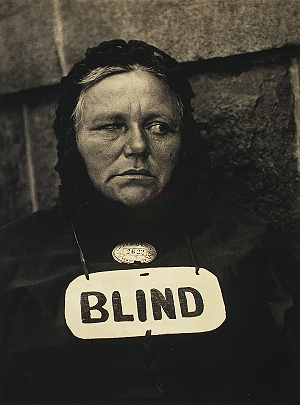
The social engineers who created a system for licensing beggars in New York never imagined that a blind woman had culture or could make culture. She herself may not have imagined it, either. In the moment when Paul Strand photographed her surreptitiously on the street in 1916, he could not have expected that one day blind photographers would reverse the camera’s gaze. Read Curiosity & The Blind Photographer. [MiT5 2007]
Pingback: » A New, Global Oil Quandary: Costly Fuel Means Costly Calories