About the Flaneur
![Gustave Caillebotte. Paris Street, Rainy Day (La Place de l’Europe, temps de pluie). 1877. Oil on canvas. Art Institute of Chicago. [Source: Wikimedia Commons]](../../wp-content/uploads/2009/02/gustave_caillebotte_paris_street_rainy_day_1877_wiki.jpg "gustave_caillebotte_paris_street_rainy_day")
I walk through my blindness the way I wander down streets in Paris: unfettered and alive, alert to the raw material of the senses. I am a flaneur. Come along with me. Just don’t try to take my arm, unless I ask. What’s a flaneur? Read the first post, Return of the Flaneur to Galerie Vivienne. After that, try Foot Rage and the Blind Flaneur. Then stay tuned.Letting Go of Sight
![Fog at Isle Royale [Source: wildmengoneborneo.com]](../../wp-content/uploads/2008/04/isle_royale_fog.jpg "Fog at Isle Royale [Source: wildmengoneborneo.com]")
I’ve canoed on Lake Superior for almost as many years as I’ve been losing eyesight. I return year after year like a migrating loon to learn the other side of a slow, uncertain process that we could call “going blind.” After 35 years with the lake as my teacher, I know what lies on the other side. I call it letting go of sight. Read Big Water. See more about the Great Lakes.Not This Pig
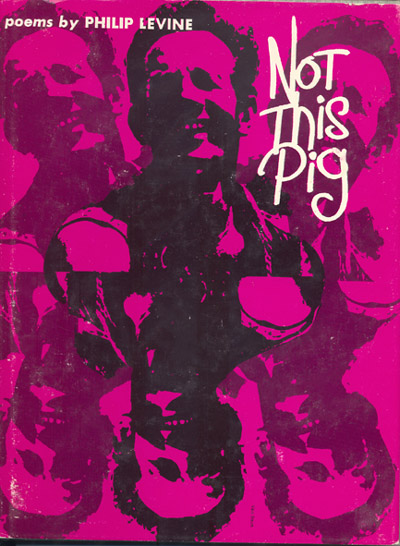 If there is an emerging genetic underclass, I could run for class president or class clown. Read more in Not This Pig (2003).
Media in Transition @ MiT
Disabled Americans today have to negotiate for the kinds of accommodations made for FDR, and the caveat “reasonable accommodation” is built into the law. President Franklin Roosevelt did not have to negotiate. He could summon vast resources of the federal government – money as well as brains – to accomplish the work of disability. And it was accomplished with such thoroughness and efficiency that its scale could be called the Accessibility-Industrial Complex had it been directed toward public accommodations and not solely the needs of a single man. Read FDR and the Hidden Work of Disability [MiT8 2013]
Shepard Fairey claimed that his posterization of a copyrighted AP news photo of Barack Obama was a transformative work protected by the fair use doctrine. In other words, it was a shape-shifter. I claim fair use, too, when I reproduce and transform copyrighted works into media formats that are accessible to me as a blind reader. Read Shape-Shifters in the Fair Use Lab [MiT6 2009]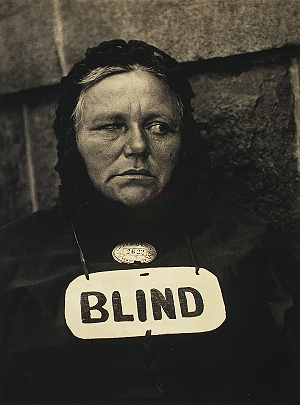
The social engineers who created a system for licensing beggars in New York never imagined that a blind woman had culture or could make culture. She herself may not have imagined it, either. In the moment when Paul Strand photographed her surreptitiously on the street in 1916, he could not have expected that one day blind photographers would reverse the camera’s gaze. Read Curiosity & The Blind Photographer. [MiT5 2007]
Tag Archives: film
Roger Ebert’s Computer Voice Will Break Down Barriers
I was very pleased too hear Roger Ebert speak via voice synthesizer yesterday on NPR. I listen to the same kind of machine voice day in, day out. That’s how I read, how I write and edit the words you’re reading now. It isn’t weird or the stuff of science fiction, like 2001: A Space Odyssey. It’s no big deal. Like disability itself, it’s an everyday fact of life. Ebert’s comfort level with his surrogate voice will help a lot of people to get used to that kind of accommodation, too. Continue reading
William Hurt Listens To Stanislavski: “Breathe The Ethic Into The Play”
I paid attention to a Fresh Air interview this morning when I heard William Hurt talk about an ethical approach to the craft of acting. He described the process he followed to prepare for a single scene in the film A History of Violence, which he resists calling a cameo, for which he received an Oscar nomination in 2005. In the interview he quoted Russian director Constantin Stanislavski on the core ethos of method acting.
Serbia Swoons For Canadian Actor Who Played Nick Savage. Nick Who?
In 1991 he portrayed the buff detective in a cheesy TV show called “Sweating Bullets” (aka “Tropical Heat”). Today he lives with his parents in Brampton, Ontario. Maybe his star faded in Tinsel Town, but he’s feted like a rock star in Belgrade, where his reruns earned rebellious cultural capital even after Canada helped NATO to bomb Serbia in 1999. Rob Stewart learned about his own legend from a Facebook fan page. So what’s an underemployed actor to do? Fly to Belgrade to heal Canadian-Serbian relations, of course, and make a documentary film about it.
Shed A Tear For The Subversion of Images… and Hackneyed Colonialism
I admit it. When I compared Man Ray’s “Emak-Bakia” to Avatar the other day, I was listening to the crasser angels of search engine optimization. You know, the ones that tell you to forget everything you ever learned about writing clever magazine headlines. Just pack every Google ad word you can into the blog title. So I threw in Avatar and nothing happened.
Was Man Ray’s “Emak-Bakia” the “Avatar” of the 1920s?
When Man Ray’s short film “Emak-Bakia” debuted in Paris in 1926, critical opinion was mixed. One angry viewer shouted that it gave him a headache and hurt his eyes, to which another retorted, “Shut up!” A brawl ensued, which spread through the audience and spilled into the street. Then the police arrived to quell the riot.