About the Flaneur
![Gustave Caillebotte. Paris Street, Rainy Day (La Place de l’Europe, temps de pluie). 1877. Oil on canvas. Art Institute of Chicago. [Source: Wikimedia Commons]](../../wp-content/uploads/2009/02/gustave_caillebotte_paris_street_rainy_day_1877_wiki.jpg "gustave_caillebotte_paris_street_rainy_day")
I walk through my blindness the way I wander down streets in Paris: unfettered and alive, alert to the raw material of the senses. I am a flaneur. Come along with me. Just don’t try to take my arm, unless I ask. What’s a flaneur? Read the first post, Return of the Flaneur to Galerie Vivienne. After that, try Foot Rage and the Blind Flaneur. Then stay tuned.Letting Go of Sight
![Fog at Isle Royale [Source: wildmengoneborneo.com]](../../wp-content/uploads/2008/04/isle_royale_fog.jpg "Fog at Isle Royale [Source: wildmengoneborneo.com]")
I’ve canoed on Lake Superior for almost as many years as I’ve been losing eyesight. I return year after year like a migrating loon to learn the other side of a slow, uncertain process that we could call “going blind.” After 35 years with the lake as my teacher, I know what lies on the other side. I call it letting go of sight. Read Big Water. See more about the Great Lakes.Not This Pig
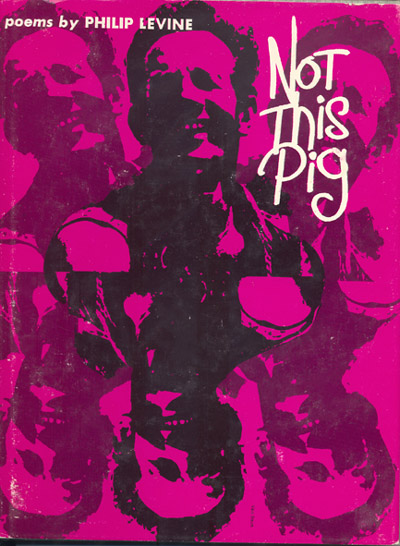 If there is an emerging genetic underclass, I could run for class president or class clown. Read more in Not This Pig (2003).
Media in Transition @ MiT
Disabled Americans today have to negotiate for the kinds of accommodations made for FDR, and the caveat “reasonable accommodation” is built into the law. President Franklin Roosevelt did not have to negotiate. He could summon vast resources of the federal government – money as well as brains – to accomplish the work of disability. And it was accomplished with such thoroughness and efficiency that its scale could be called the Accessibility-Industrial Complex had it been directed toward public accommodations and not solely the needs of a single man. Read FDR and the Hidden Work of Disability [MiT8 2013]
Shepard Fairey claimed that his posterization of a copyrighted AP news photo of Barack Obama was a transformative work protected by the fair use doctrine. In other words, it was a shape-shifter. I claim fair use, too, when I reproduce and transform copyrighted works into media formats that are accessible to me as a blind reader. Read Shape-Shifters in the Fair Use Lab [MiT6 2009]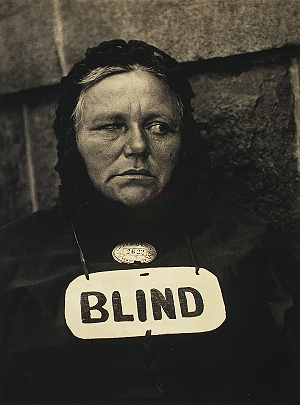
The social engineers who created a system for licensing beggars in New York never imagined that a blind woman had culture or could make culture. She herself may not have imagined it, either. In the moment when Paul Strand photographed her surreptitiously on the street in 1916, he could not have expected that one day blind photographers would reverse the camera’s gaze. Read Curiosity & The Blind Photographer. [MiT5 2007]
Tag Archives: OTM
Hamster Cages, Participatory Surveillance, and the Quantified Self
I’m still catching up on news and media I missed last week while I was pondering media theory at MiT7.The conference’s fundamental issue crystallized for me during the Saturday night forum (Power and Empowerment) when Richard Rogers invoked the phrase “participatory surveillance to” suggest the dark side of platforms monetizing user-generated content (a.k.a. “hamster cages”). Unbeknownst to me at the time was last week’s edition of On the Media, devoted to data, with a story on The Personal Data Revolution. It makes me wonder, whose revolution is it, anyway, and whose wallet should I watch? Continue reading
Steven Rosenbaum on the “Curation Nation”
What if instead of relying on search engines to get our information, we relied on each other - friends, experts, journalists - to deliver us information by way of carefully curated websites? Steven Rosenbaum, CEO of Magnify.net and author of “Curation Nation: How to Win in a World Where Consumers” are Creators tells OTM that our curated content future may have already arrived.
Ethan Zuckerman the Internet’s Global Impact
On the Media’s Feb. 18 show was recorded before a live audience using a talk show debate format in which the hosts represented two Manichean perspectives on an oversimplified question about the Internet’s role in society. In the show’s second segment, after his name was invoked as the media guru on the Net’s global impact, Ethan Zuckerman walked on stage like Marshall McLuhan in Annie Hall to quip, “I think you just completely misunderstand my work.” Nice gag.Here is the audio embed, and below are several takeaway points from the transcript.
Locating A Public Sphere On The Arab Street
This week’s images from Tahrir Square in Cairo give a passionate urgency to the metaphor of the Arab street. Since 9/11, American media have used the phrase widely as shorthand for Arab public opinion. But a researcher at York University in Toronto says its meanings are more nuanced. As it’s used in American media, the term often is associated with Irrationality, volatility, and violence. In Arab media the usage is more affirmative, suggesting “main street” or the will of the people. Arab media also apply it globally, speaking in turn about the American street. Why don’t we say that? I hear it as a metaphor for the public sphere, and the free discourse that sustains it. Where else would a flaneur locate it?
Matching Social Register to Social Media
The Social Media Ecosystem – a.k.a. the Internet – is overpopulated with blogs and tweets that tell you 5 things you should do to succeed at blogging and tweeting. Anyone contemplating a career change to “social media consultant” should check … Continue reading