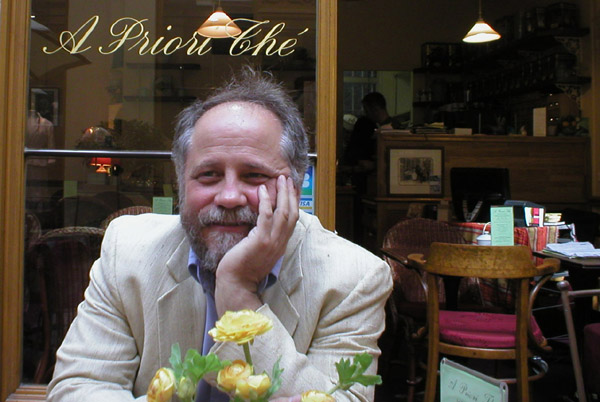
 When I’m in Paris I cross the river at least once to walk up Rue Vivienne, which runs north from the Louvre and Palais Royale. Compared to the grand boulevards, Rue Vivienne feels like a narrow, unassuming street, but it crosses the heart of a thriving financial district. Here one finds the Bourse, the Paris Stock exchange, along with most of the city’s numismatiques and gold dealers. The street bears a rich legacy of money and books stretching back to Louis XIV. Rue Vivienne flanks one side of he Bibliothèque Nationale. Across the street from that shrine of French letters is an entrance to Galerie Vivienne, one of the 19th-century arcades that so intrigued Walter Benjamin.
Whenever I go to Rue Vivienne I’m sure to conclude the sortie with a stroll in the arcade, elegantly restored now to belle epoque splendor. I come to rest at a salon de thé with several bright tables placed beneath skylights in the main passage. That’s where this photo was taken one morning last June. When I look at it now I remember how absolutely happy I felt just to be sitting there. And why not? I had a Louis d’or in my pocket. There were fresh flowers on the table. I was on holiday with Ms. Modigliani in the City of Love. We were footloose and fancy-free with no agenda beyond finding a suitably amiable sidewalk café for lunch. We were flaneurs.
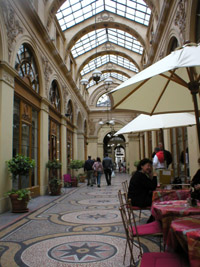 Most who know the word trace their knowledge to Walter Benjamin’s 1929 essay, ‘The Return of the Flaneur.” He resisted definitions there, and I will do the same here. His cousin, Hannah Arendt, explained that Benjamin was less concerned with ideas than phenomena. He was a metaphorical, even poetic, thinker. He preferred the rich ambiguity of images to the rigor of systematic thought. He was a flaneur.
I don’t know whether Galerie Vivienne was an arcade that Benjamin frequented, but I feel close to him whenever I go there. In the moment the photo was snapped, there was time to muse about Benjamin’s passion for the streets of Paris. There was time, too, for remembering how he fled the city in 1940 but couldn’t outrun the Fascists in the end. Feeble and frightened after crossing the Pyrenees on foot, he swallowed an overdose of morphine just hours before the Gestapo tracked him down in a sad little Spanish seaport. The Nazis searched but never found the manuscript for his vast, unfinished master work about 19th-century Paris, an ambitious project that reached for the scope of Marx’s Das Kapital. The manuscript was hidden safely across the street from Galerie Vivienne in the stacks of the Bibliothèque Nationale. It surfaced a few years after the war and was published in English in 1999 as The Arcades Project.
I will have much more to say here about Walter Benjamin, about Paris, about what it means to be a blind flaneur. For now, let me invoke Benjamin as the tutelary spirit behind this blog. One quotation from “The Return of the Flaneur” suggests the places I plan to inhabit here:
Just as every tried-and-true experience also includes its opposite, so here the perfected art of the flaneur includes a knowledge of “dwelling.” The primal image of “dwelling,” however, is the matrix or shell-that is, the thing which enables us to read off the exact figure of whatever lives inside it. Now, if we recollect that not only people and animals but also spirits and above all images can inhabit a place, then we have a tangible idea of what concerns the flaneur and of what he looks for. Namely, images, wherever they lodge. The flaneur is the priest of the genius loci.
![Gustave Caillebotte. Paris Street, Rainy Day (La Place de l’Europe, temps de pluie). 1877. Oil on canvas. Art Institute of Chicago. [Source: Wikimedia Commons]](../wp-content/uploads/2009/02/gustave_caillebotte_paris_street_rainy_day_1877_wiki.jpg "gustave_caillebotte_paris_street_rainy_day")
![Fog at Isle Royale [Source: wildmengoneborneo.com]](../wp-content/uploads/2008/04/isle_royale_fog.jpg "Fog at Isle Royale [Source: wildmengoneborneo.com]")
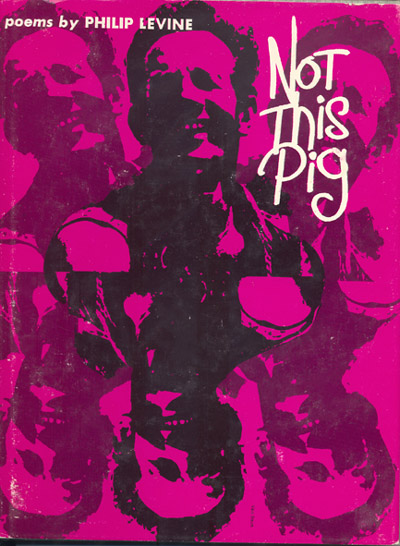 If there is an emerging genetic underclass, I could run for class president or class clown. Read more in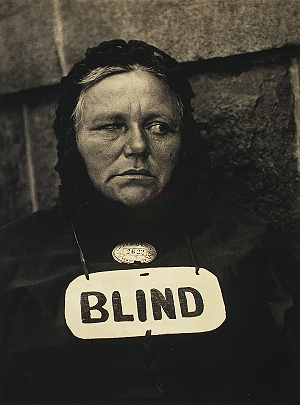
I am thrilled to discover your blog - it is a treasure! You write beautifully and I am looking forward to experiencing Paris “through your eyes” and learning from you. Thanks.
Thanks for reading, Sara.
Pingback: Looking Back (Demurely) Over A Quarter Million Page Views - a blind flaneur
The ‘primal’ image of a dwelling. There is NO such thing…and as for the rest…words words words…to me at least. And I love words…being an ardent Proust fan …but they should mean something. Not just pretend to in a fake way……I actually was just looking up Picasso’s portrait of Lee Miller…
Wow… I think that I am a flaneur and I just never knew it until now! Only instead of the streets of Paris, it’s the seawall of Vancouver where I walk. Maybe I walk too quickly to be considered a flaneur, and I’m likely to disappear into a forest - when I find one - to escape the concrete. But the bit about walking in order to experience the city… that is it! Sometimes I feel like I am building a version of the city in my head, one walk at a time, thirteen years of meandering lines overlapping to slowly fill in the blanks.
We have a lot of fog out here too… my favourite is when I’m standing on a balcony and the fog is so thick I can’t see the ground - I imagine that the ground doesn’t exist, that I am simply floating in the clouds.
Sounds to me like you are a flaneur, for sure. It isn’t about the pace of walking or typologies of landscape where you walk. It’s about the mapping in memory, a mindfulness of inhabiting landscapes as you walk.
pleasure to read this stuff —
Pingback: Finding a Flaneur in “The Moviegoer” - a blind flaneur
exquisite writing you flaneur you. !
Thank you, Barbara.