About the Flaneur
![Gustave Caillebotte. Paris Street, Rainy Day (La Place de l’Europe, temps de pluie). 1877. Oil on canvas. Art Institute of Chicago. [Source: Wikimedia Commons]](../../wp-content/uploads/2009/02/gustave_caillebotte_paris_street_rainy_day_1877_wiki.jpg "gustave_caillebotte_paris_street_rainy_day")
I walk through my blindness the way I wander down streets in Paris: unfettered and alive, alert to the raw material of the senses. I am a flaneur. Come along with me. Just don’t try to take my arm, unless I ask. What’s a flaneur? Read the first post, Return of the Flaneur to Galerie Vivienne. After that, try Foot Rage and the Blind Flaneur. Then stay tuned.Letting Go of Sight
![Fog at Isle Royale [Source: wildmengoneborneo.com]](../../wp-content/uploads/2008/04/isle_royale_fog.jpg "Fog at Isle Royale [Source: wildmengoneborneo.com]")
I’ve canoed on Lake Superior for almost as many years as I’ve been losing eyesight. I return year after year like a migrating loon to learn the other side of a slow, uncertain process that we could call “going blind.” After 35 years with the lake as my teacher, I know what lies on the other side. I call it letting go of sight. Read Big Water. See more about the Great Lakes.Not This Pig
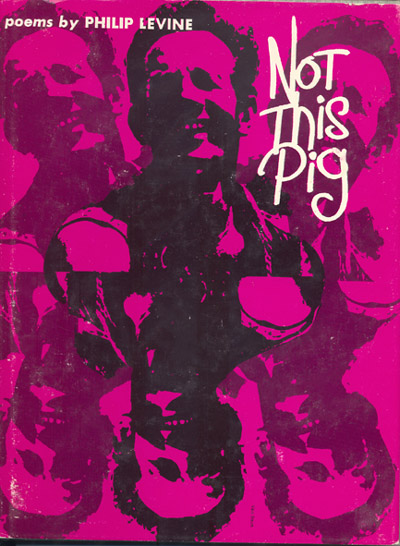 If there is an emerging genetic underclass, I could run for class president or class clown. Read more in Not This Pig (2003).
Media in Transition @ MiT
Disabled Americans today have to negotiate for the kinds of accommodations made for FDR, and the caveat “reasonable accommodation” is built into the law. President Franklin Roosevelt did not have to negotiate. He could summon vast resources of the federal government – money as well as brains – to accomplish the work of disability. And it was accomplished with such thoroughness and efficiency that its scale could be called the Accessibility-Industrial Complex had it been directed toward public accommodations and not solely the needs of a single man. Read FDR and the Hidden Work of Disability [MiT8 2013]
Shepard Fairey claimed that his posterization of a copyrighted AP news photo of Barack Obama was a transformative work protected by the fair use doctrine. In other words, it was a shape-shifter. I claim fair use, too, when I reproduce and transform copyrighted works into media formats that are accessible to me as a blind reader. Read Shape-Shifters in the Fair Use Lab [MiT6 2009]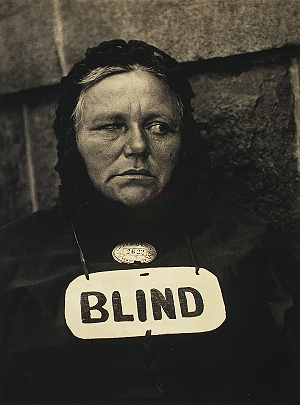
The social engineers who created a system for licensing beggars in New York never imagined that a blind woman had culture or could make culture. She herself may not have imagined it, either. In the moment when Paul Strand photographed her surreptitiously on the street in 1916, he could not have expected that one day blind photographers would reverse the camera’s gaze. Read Curiosity & The Blind Photographer. [MiT5 2007]
Tag Archives: accessibility
Roger Ebert’s Computer Voice Will Break Down Barriers
I was very pleased too hear Roger Ebert speak via voice synthesizer yesterday on NPR. I listen to the same kind of machine voice day in, day out. That’s how I read, how I write and edit the words you’re reading now. It isn’t weird or the stuff of science fiction, like 2001: A Space Odyssey. It’s no big deal. Like disability itself, it’s an everyday fact of life. Ebert’s comfort level with his surrogate voice will help a lot of people to get used to that kind of accommodation, too. Continue reading
How Stimulating Is Accessible Porn for the Blind?
Like many accessible technologies, it sounds like a clever concept but economies of scale put it beyond the reach of most blind people. A thousand sexy words are cheaper.
Deconstructing André Breton To Feed The Scanner
Finding an efficient workflow for accessibility – this is the story of my life as a reader and writer. I was reminded of this today when VirtualDavis posted the video, Memories of a Scanner, pointing to its possibilities as a new genre of digital story-telling. I immediately thought of the title of Vladimir Nabokov’s memoir, Speak, Memory. Blind readers use scanners every day to process the flotsam and jetsam of visual culture. How could we adapt this genre of scanner narratives to document our experiences and workflows – and, of course, make them fully accessible through the process?
Pranav Mistry’s SixthSense: Translating the Gesture of Writing into Symbolic Communication
At TEDIndia, Pranav Mistry demos several tools that help the physical world interact with the world of data — including a deep look at his SixthSense device and a new, paradigm-shifting paper “laptop.” In an onstage Q&A, Mistry says he’ll open-source the software behind SixthSense, to open its possibilities to all.
The Most Over-Hyped Tablet Since Moses Came Down From The Mountain
As one who has lost the ability to read printed books, I’m always searching for that richer context when the text itself is inaccessible to me. I thrive in the proliferation of book excerpts and videos, reviews and interviews available now on the Internet. I have more ways to learn about books than ever before. In the end, though, what I want is the book itself in an accessible format. Given Apple’s penchant for imperialistic control of devices and DRMs, I doubt that the latest tablet handed down from the mountain will reach me as a reader.